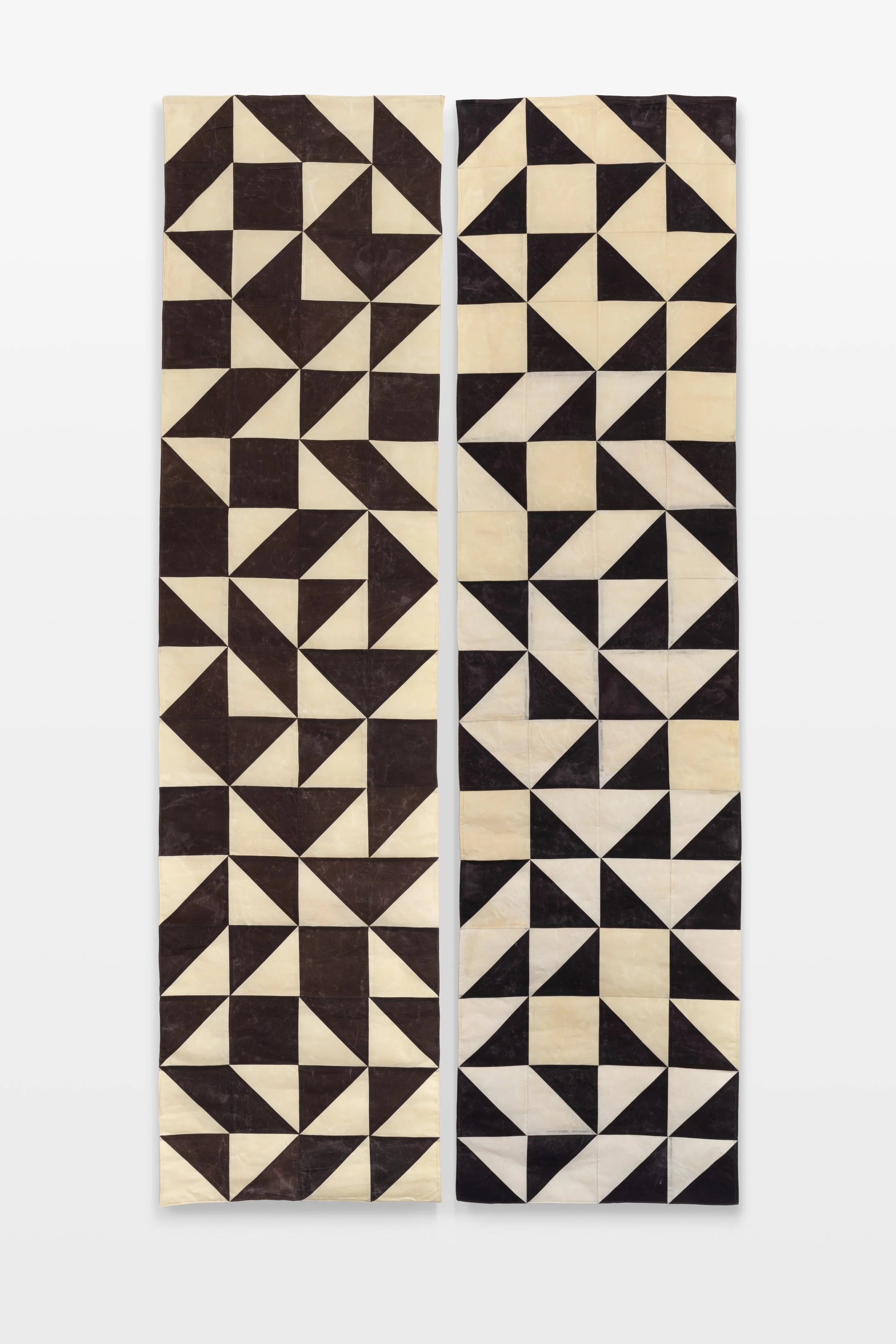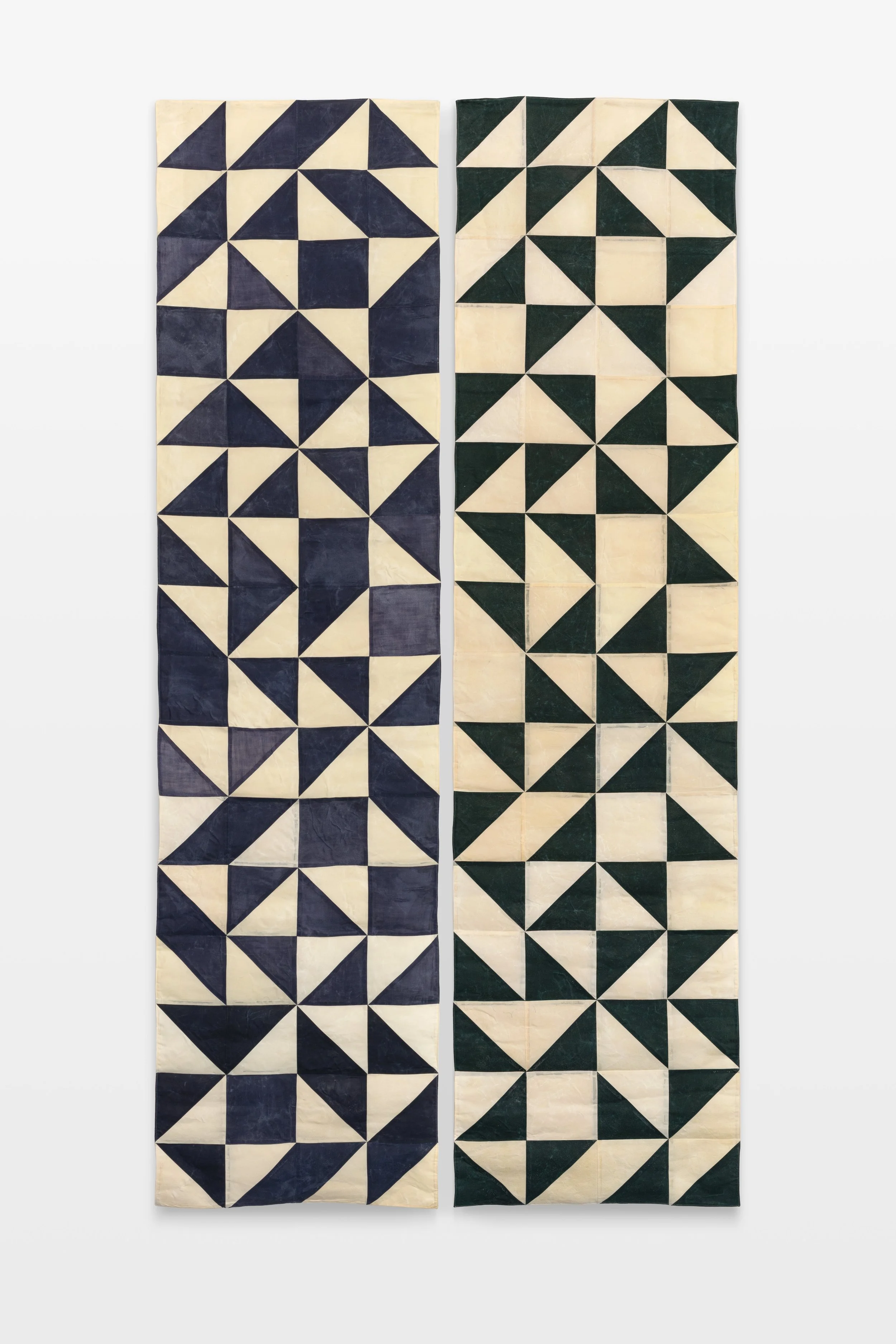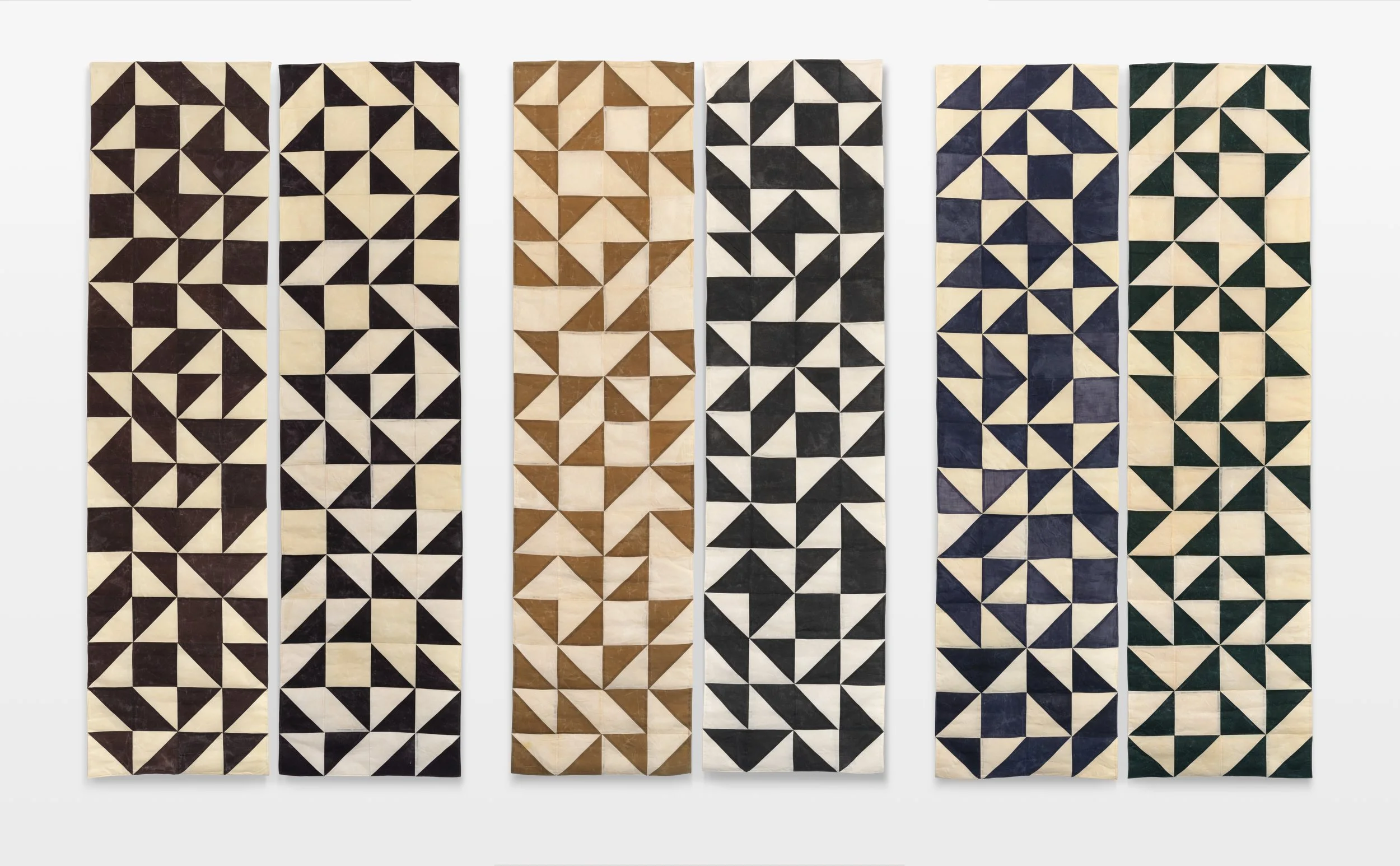
DR. XXI 1-6 (Tarpaulins after Albers), 2024
Quilted recycled cloth, beeswax.
This series of tarpaulins draw reference from Anni Albers’ sketchbook, filled with graphic drawings produced between 1970-1980. Published after her death, the notebook offers a rare insight into Albers’ drawing practice while allowing their intention to remain ambiguous. It is unknown if Albers envisaged these drafts as woven wall hangings, graphic works or something else – but rather, the drawings emphasise the meticulous nature of her draftsmanship and the way she approached the construction of complex patterning – piece by piece, line by line.
Drawing on his familial textile practices, Griffiths realises the drawing DR. XXI 1976, not as means to construct a weaving, but as a graphic application to six large-scale tarpaulins. Here, the drawings have been considered a quilting pattern and constructed from donated or recycled fabric from his Grandparent’s quilt studio – a foundational space in Griffiths’ early life that remains a place of collaboration and creative problem solving. The resulting panels are synonymous with classic ‘half-square-triangle’ quilts that have, in recent times, become a caricature of domestic crafting.
Once quilted, Griffiths has taken the panels and applied a coating of molten beeswax. This process borrows from a 15th century mariners technique to oil and grease sailcloth - a technique the artist has been studying – but too, one that is synonymous with colonial settlement in Australia - referencing the stockman’s Drizabone. The process of waxing waterproofs the cotton and transforms it into something utilitarian; purposefully confusing and questioning the value we associate with cloth.
Through the application of a simple treatment, the quilt cum tarpaulins confound ideas of soft/hard, domestic/skilled labour, masculine/feminine, and bring to the fore a critical conversation about our relationship with craft practices, their histories and ultimately exposes the value in which we place on cloth as contextual.
This work was exhibited in Fluid Flax, curated by Belinda Hungerford.
Exhibited at the New England Regional Art Museum
Photos by Jessica Maurer