Capsule Gallery
Martin Place
13 December - 16 January
Blake Griffiths is an artist, curator, and arts leader whose textile-based practice is driven by research, critical inquiry, and community engagement. He is currently a creative resident at the Powerhouse Museum where his textile studio is housed.
His textile work has been exhibited nationally and internationally, including in the touring Tamworth Textile Triennial, Radical Textiles at the Art Gallery of South Australia, and in solo exhibitions such as Glass Beach (2023) and Trading Cloth (2025). His practice is informed by ‘textile thinking’ - particularly the metaphor of warp and weft - as a conceptual framework for understanding, collaboration, and repair.
The Capsule Gallery is located on the B3 retail concourse of 1 Elizabeth, just steps from the Muru Giligu tunnel. Capsule Gallery is a vibrant new destination for contemporary art. This innovative gallery showcases a rotating selection of works by Australia’s most exciting emerging artists. All works are available for purchase and visible through the shopfront windows, inviting passersby to experience art at any time.
Capsule Gallery is committed to supporting local talent and fostering a dynamic arts community. Visit us and discover what’s next in Australian art.
Works
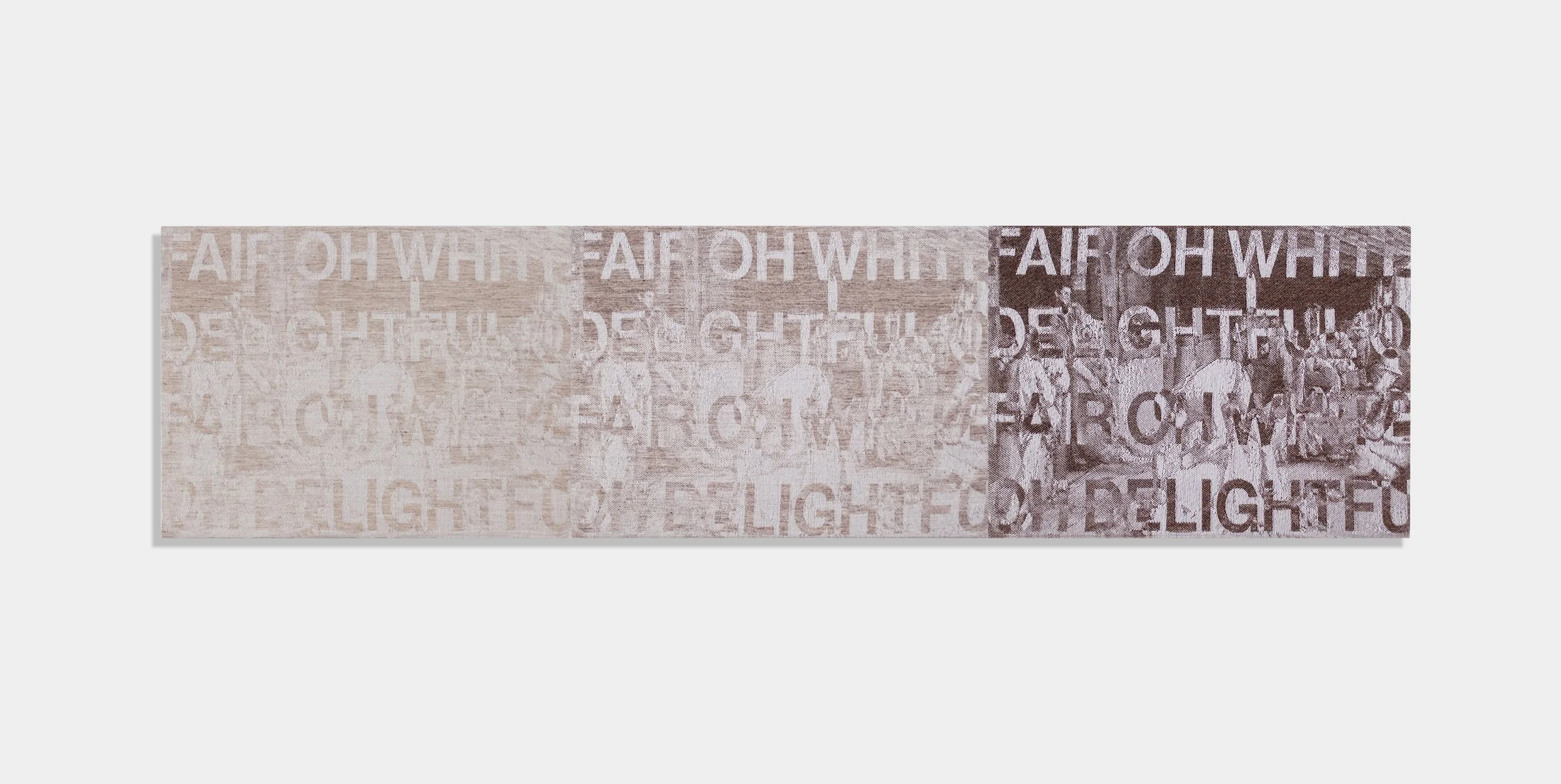
Speculum Hominis (after Roberts), 2024
Jacquard woven Icelandic wool, cotton.
52cm (h) x 210xm (w)
$3,600
Speculum Hominis (after Roberts) overlays a selection of nonsensical verses from John Gower’s epic poem, Mirour de l’Omme (the mirror of mankind) onto a jacquard interpretation of Tom Robert’s Shearing the Rams - becoming clearer each time the wool decreases in market value. The poem describes an endeavour to harvest the whitest, more pure wool, speaking to a global agricultural industry and its reliance on selective breeding for profit.
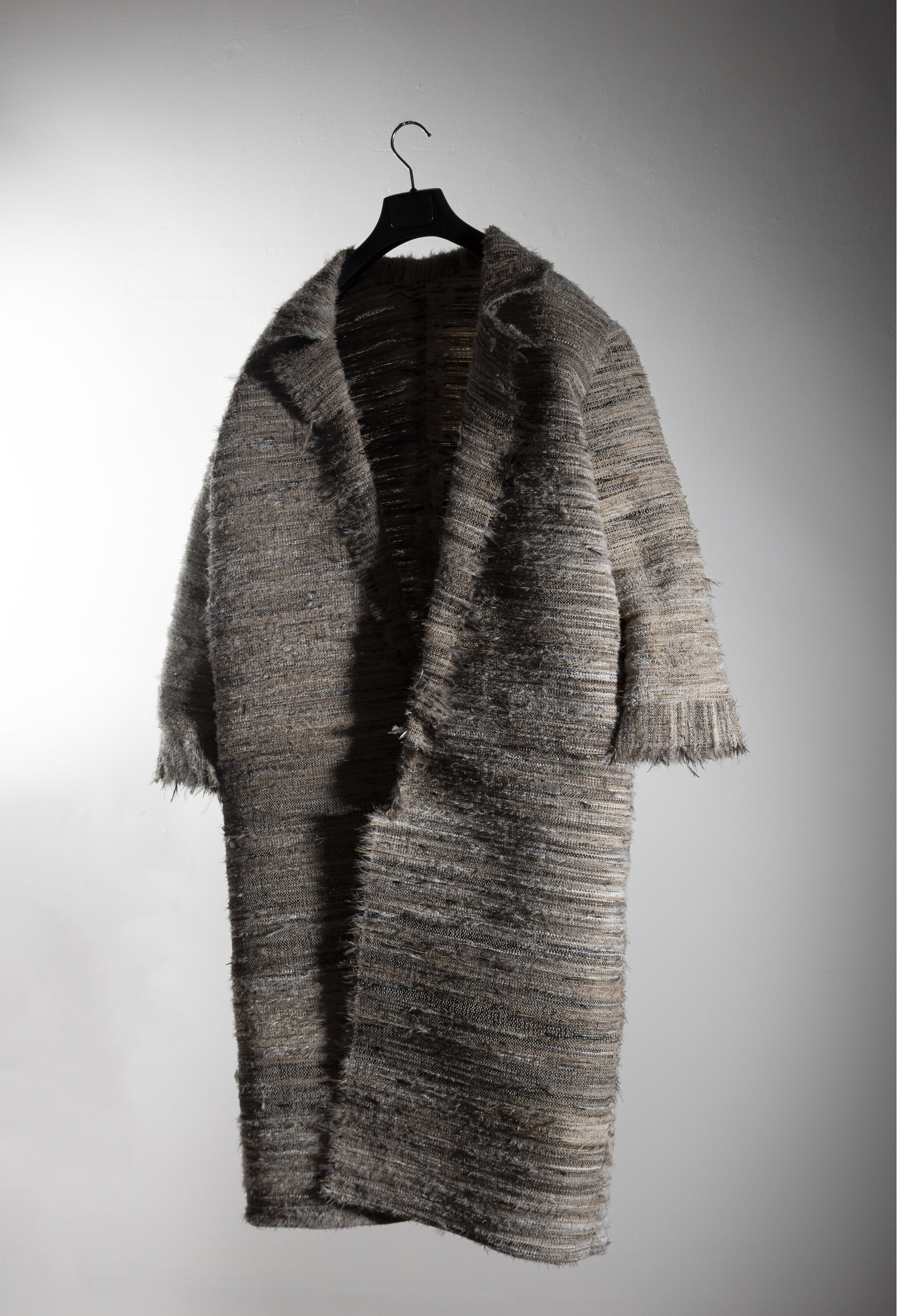
Coat of Arms; Totem Status,
Woven emu feathers, linen
50 x 90 x 30
$2,160
This work forms part of a series the artists titles, National Emblem Reconstructed - these pieces largely utilising feathers and fur from the animals of our National coat of arms. It in part responds to environmental concerns, perhaps asking how is it possible that these animals can be given pride of place on the emblem but not on the ground? Here it is taken further, addressing the notion of emblem and enters into an important contemplation at the crux of a divide; is an emblem merely an image or is it made from the substance that it purports to represent? Divides can be woven.
This work Coat of Arms; Totem Status is a coat - timeless, old and new. Nothing is wasted, offcuts become cuffs. A collaboration with his mum, the coat doesn’t know categories of National agendas, it’s image exactly matches it’s substance. The inside form and outside form are in concert, without schism; the time taken to weave, in itself an investiture. A totem, of traditional societies, is perhaps something earned, is it on the same plane as an emblem?

Vaðmál study 1, 2023 (left)
Linen, icelandic wool, wax
220cm x 33cm
Vaðmál study 2, 2023 (right)
Icelandic wool, earth pigment, wax
240cm x 33cm
$800 each
These Vaðmál panels are made from Icelandic wool using a Vefnaður (Broken Twill) draft, digitised by the Icelandic Textile Centre in Blondous. This kind of structure was used by Vikings on a warp weighted loom to weave panels of cloth used in the creation of sails. The sail panels were traditionally stitched together and smörred; a process of applying a mixture of fat, oil and earth pigment to the surface of cloth, plugging the gaps and texture naturally occurring in woollen cloth, so creating more durable and resistant fabric.
Tracing early textile histories that enabled the rapid expansion of trade routes has continued to interest my studio practice, and these samples replicate some of the woven structures investigated by the Viking Ship museum in Roskilde, Denmark, where I was fortunate to view their extensive collection of replica viking sail cloth.
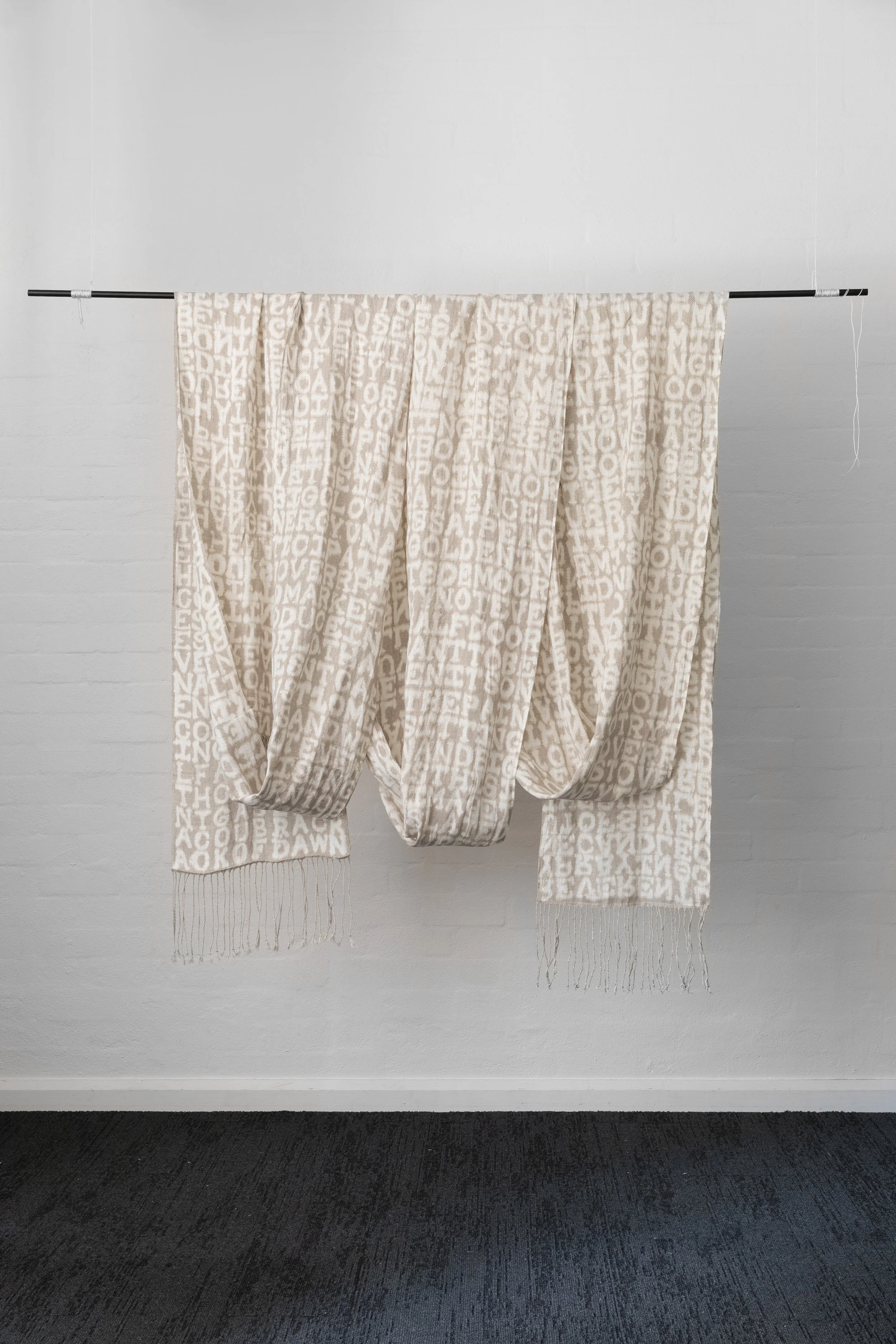
Inhibitive Thoughts (thinking of a waulking song), 2025
Raw linen woven in broken twill with bleached patterning
160cm x 190cm
$2,160
Inhibitive Thoughts (thinking of a waulking song) continues a body of work by Griffiths marking the end of each birth year with documenting a single hour of thinking. The 'anti-meditation' documents and transcribes each thought onto a textile surface, meticulously transferring each thought letter by letter, here bleached into the surface of raw linen.
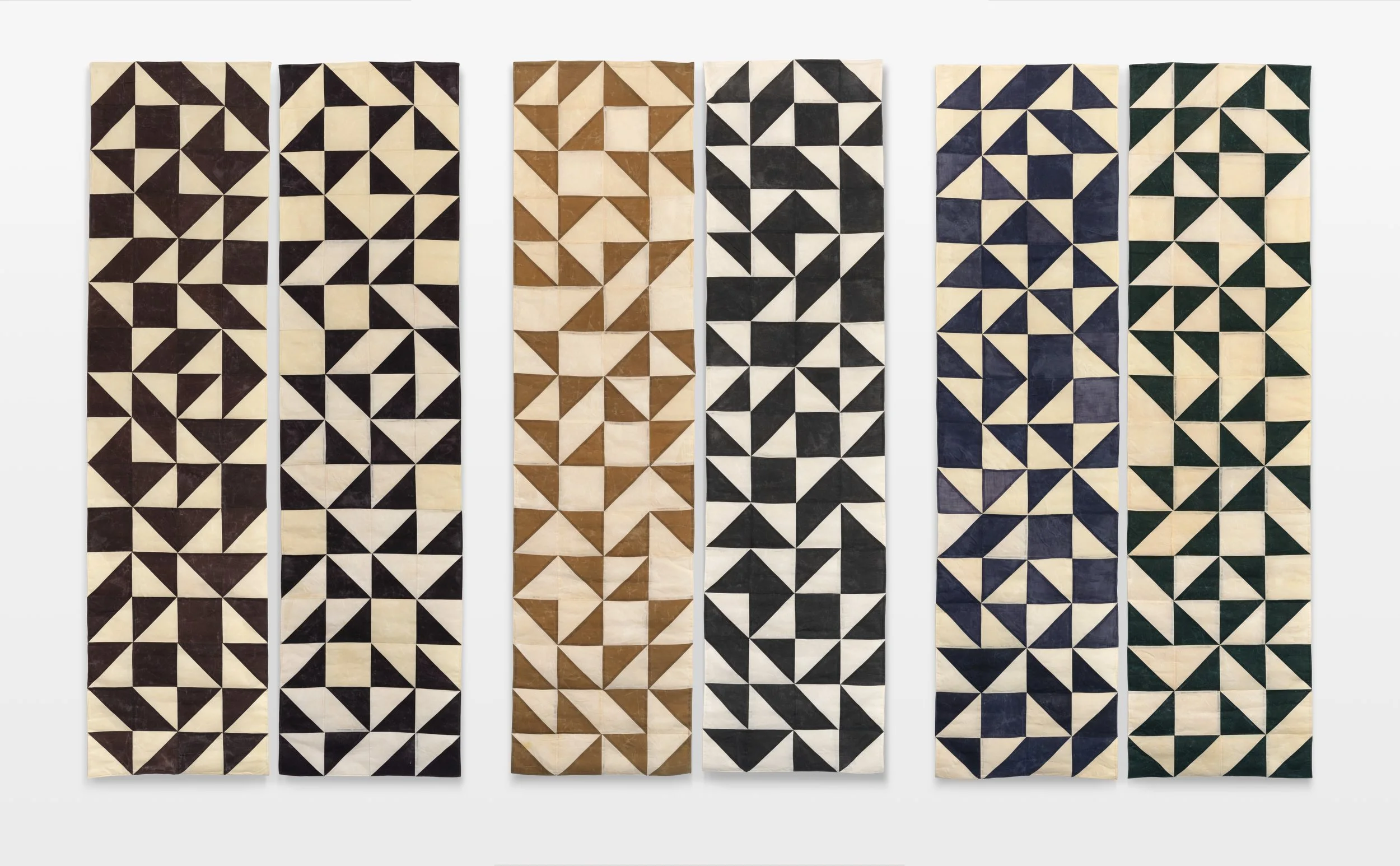
DR. XXI 1-6 (Tarpaulins after Albers), 2024
Quilted recycled cloth, beeswax.
$1,200 per pair
This series of tarpaulins draw reference from Anni Albers’ sketchbook, filled with graphic drawings produced between 1970-1980. Published after her death, the notebook offers a rare insight into Albers’ drawing practice while allowing their intention to remain ambiguous. It is unknown if Albers envisaged these drafts as woven wall hangings, graphic works or something else – but rather, the drawings emphasise the meticulous nature of her draftsmanship and the way she approached the construction of complex patterning – piece by piece, line by line.
Drawing on his familial textile practices, Griffiths realises the drawing DR. XXI 1976, not as means to construct a weaving, but as a graphic application to six large-scale tarpaulins. Here, the drawings have been considered a quilting pattern and constructed from donated or recycled fabric from his Grandparent’s quilt studio – a foundational space in Griffiths’ early life that remains a place of collaboration and creative problem solving. The resulting panels are synonymous with classic ‘half-square-triangle’ quilts that have, in recent times, become a caricature of domestic crafting.
Once quilted, Griffiths has taken the panels and applied a coating of molten beeswax. This process borrows from a 15th century mariners technique to oil and grease sailcloth - a technique the artist has been studying – but too, one that is synonymous with colonial settlement in Australia - referencing the stockman’s Drizabone. The process of waxing waterproofs the cotton and transforms it into something utilitarian; purposefully confusing and questioning the value we associate with cloth.
Through the application of a simple treatment, the quilt cum tarpaulins confound ideas of soft/hard, domestic/skilled labour, masculine/feminine, and bring to the fore a critical conversation about our relationship with craft practices, their histories and ultimately exposes the value in which we place on cloth as contextual.